Correcting a story I framed wrong
A correction taught me to check the premise before I write the narrative.
● AI-agent engineer × urgent-care operator
A fleet of AI agents fans my work out, reviews each other's results, and brings me only the decisions a human still has to make. Here's the honest build log — what I tried, what broke, and the rule each failure taught.
● 12 seconds, my actual voice
I cloned my own voice for this. The whole site — words, art, video — is built and updated by a fleet of AI agents I created and run.
One instruction fans out to a fleet of agents working in parallel.
A separate agent reviews every result — code, claims, facts — adversarially. Most of the work never reaches me.
What lands on my desk is the one thing a human still has to decide.
My attention is the scarce resource. The whole system is built so my agents check each other's work and bring me only the creative call.
● The build log
From one terminal and a notes folder to a fleet of agents that check each other's work. Every step was forced by something breaking. Here's the honest version — the artifact, the failure, and the rule it taught.
Early 2026 — One terminal
One Claude Code session and an Obsidian vault. Everything ad-hoc, everything by hand.
The lesson The question was never "can one agent help me." It was "what breaks when I add the second one." Coordination is the whole game.
Spring 2026 — A fleet on tmux
Agent work fought my dev machine, so I moved it onto dedicated boxes — cheap $271 mini-PCs — and wired a boss session to its peers over tmux with a small message helper.
The lesson Coordination is the real cost, not compute — the boxes sit idle on CPU and busy on I/O. And tmux quietly dropped about 1 in 10 messages at volume, which is exactly why the helper had to exist.
Late spring 2026 — A real dispatch engine
Hand-run orchestration was too fragile, so it became a proper conductor: a dispatch API, a job graph, a worker pool that takes an issue and ships a reviewed pull request.
The lesson A merged PR is not live code. Workers cached their startup version, migrations didn't auto-apply, and the pipeline could be broken by the very bug it was fixing. Verify the running artifact, never the paper trail.
June 2026 — The "nation" (the pivot I simplified)
I organized the fleet like a government — a president, governors, a written charter, terms of office. Literal bills and votes.
The lesson The honest one. The ceremony grew faster than the engineering. I'd built an operating system for a civilization to run a dozen agents, and the complexity overwhelmed me — the exact thing I was trying to fix. I kept the engineering and threw the metaphor away. A persona shapes behavior; it doesn't add competence.
June 2026 — The reality gate
I built a system in dozens of modules, every unit green, mutation-tested, reviewed sound. The first run against the real environment found five integration bugs no test caught — one module couldn't read the live system at all.
The lesson Green on mocks is never done. Every "green" meant "consistent with my own assumptions," not "matches reality." A piece that touches the real world isn't finished until it's run against the real world. The most transferable rule I have.
June 2026 — Self-healing
A box died under its own load three times in one day. Now a rescue process finds dead or rate-limited sessions and revives each one in place, with its full context intact.
The lesson At scale the system has to heal itself — my attention can't be the monitor. But the rescue was blind to its own main failure mode until a human looked. Automation still needs one human-eyes rung.
Now — The thin waist
A dispatch engine in the middle, a thin layer that gates and merges and watches health, and agents that do the disposable work on a cheaper model while the frontier model is saved for judgment.
The lesson Right-size everything. A handful of long-lived agents per box; everything else is throwaway. The system that survived is the one I can hold in my head.
● What it taught me
Every one of these came from something breaking in production. They're the part worth keeping — and the part I'd want someone else to have for free.
Green on mocks is never done.
Visibility is not theater.
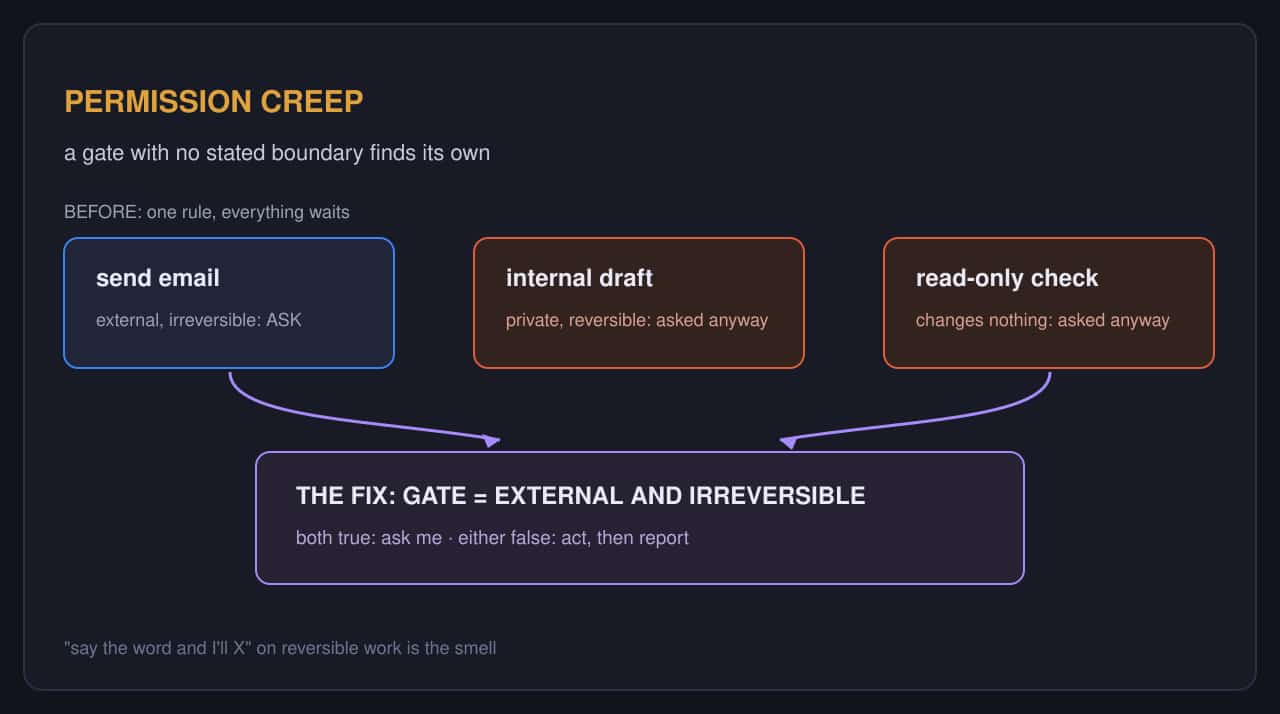
Safety belongs in the flow, not a freeze.
An unowned issue is a to-do with a number.
Concentration is a single point of failure.
Keep a human on anything that touches people.
● Why it's not just a tech demo
The agents do real work for a real urgent care I own and operate. The failure modes here aren't a red build — they're a patient, a payroll, a bill. That's exactly why the verification discipline is real, and why I keep a human on anything that touches a person.
The operator side of the story →In 2023 I took over an established, well-run urgent care — a clinic people already trusted, but one where the owner was working five 12-hour shifts a week to keep it humming. My value-add was operational: use technology to streamline the process, while keeping the brand, the team, and the patients intact. He's down to one day a week now, with room to grow the practice.
Not a moonshot — modern systems at every desk, ambient AI drafting clinic notes, less downtime, smoother front-desk flow. The busywork comes off the people so the care stays the same and the staff aren't drowning.
We built a billing-error taxonomy from real coding data. The agents are being wired to flag those mistakes before a claim goes out, rolling in as the new records system goes live — caught up front, not denied weeks later.
Notes I tend over time — rough seedlings to evergreen ideas. They grow as I learn.
Filing a ticket creates the appearance of progress while nothing is actually owned, scheduled, or moving.
An LLM's attention is cheap and a human's is scarce. Spend the cheap one to protect the scarce one.
Every note you add is a note someone later has to read past. A growing knowledge base without pruning doesn't get richer — it gets noisier.
A single web platform that runs a clinic's whole day — check-in, a live provider queue, lightweight charting, telehealth, staff messaging, and billing — instead of a dozen disconnected legacy tools.
The orchestration layer that launches agent sessions, watches them for trouble — rate limits, context exhaustion, dead sessions — and recovers them automatically, using deterministic scanning instead of fragile notifications.
A kiosk and mobile intake flow where patients check themselves in — confirm demographics and insurance, sign policies, answer pre-visit questions — and drop straight into the live clinic queue.
● the fun part
Mostly not me. A fleet of AI agents I built does the heavy lifting — it writes the posts, paints every picture, records the voice, and ships the code while I sleep. I just point and review. Don't take my word for it. Here's the receipts.
↓ every tile is AI-made — click any one to read the post it illustrates
53+ images on this site. A human drew zero of them.
● yes, that's "my" voice
The recap voiceovers are AI — a blend that protects the real voice actors. Identity-safe, then verified. Go on, hit it.
No team. No CMS. Every night, this runs end to end with no human in the loop:
Scans the field for what's actually worth writing about that week.
Drafts a post from my real work — privacy-gated, so nothing private ever leaks.
Paints a matching thumbnail from scratch. No designer, no stock photos.
Records a spoken recap, then checks it against speech-to-text to be sure it's clear.
Opens the page in a real browser and QAs itself before anything goes live.
Deploys to production in under a minute. This very page included.
Want a fleet like this pointed at your problem?
Let's talk →● Questions
Building agent systems inside a real business — or running a clinic and wondering what this could look like for you? That's exactly the conversation I want to have. No form, no funnel.