A real and growing share of my company's operations runs through a fleet of AI agents I built. I talk to one agent. It sends each task to a worker in its own copy of the repository, has another agent check the result, and brings me only the decisions a human still has to make. This page is the map of that system and the log of how it got here. The map is generated from my repository catalog, so the count is real, not remembered.
How I run it
The agent fleet that does a growing share of my company's work: what runs, how the pieces fit, and each thing that broke on the way here.
The stack(11)
The set of systems running the company right now, built and watched by one fleet of agents. Checked against my repo catalog: 11 systems as of 2026-07-21.
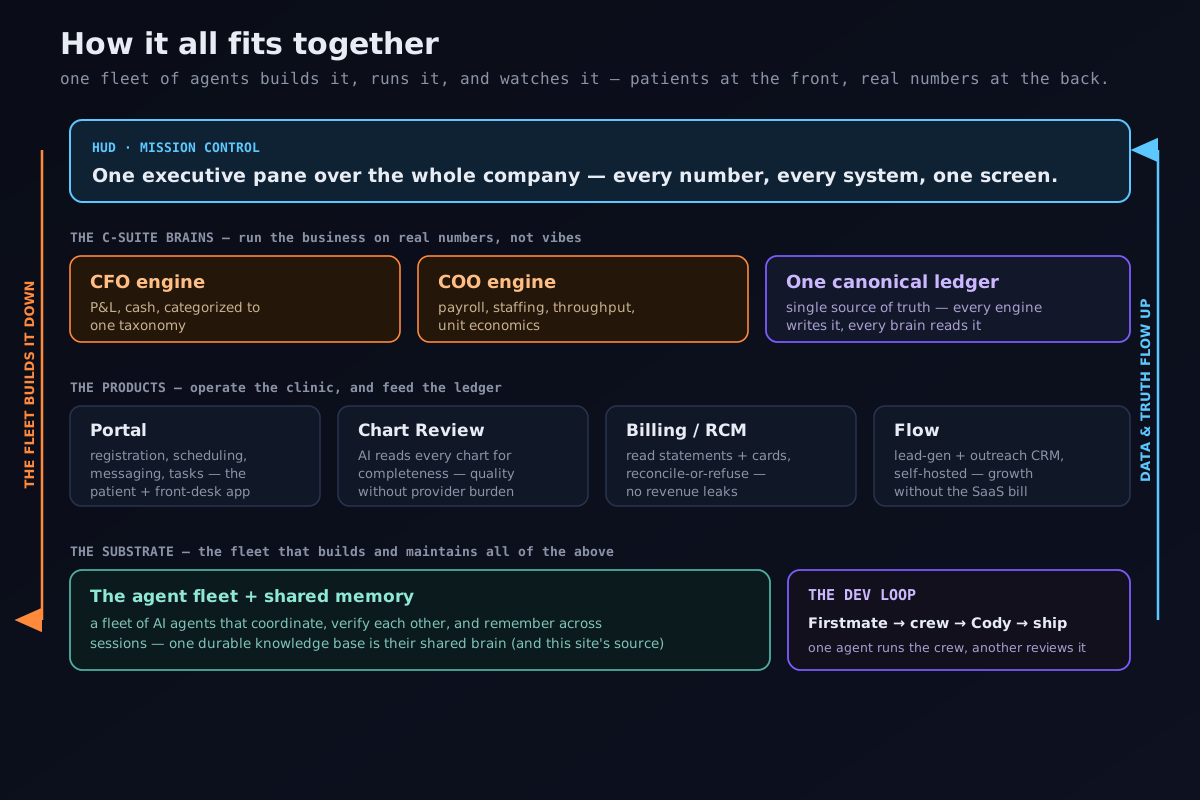
- / System / Why, what, how
-
Firstmate
the dev loop- Why
- Running more than one coding agent turns into tab-juggling: babysitting sessions and carrying context between them by hand.
- What
- The single agent I talk to. It runs a crew of agents for me and hands back finished pull requests.
- How
- It spawns one worker per task, each in its own isolated copy of the repo, supervises them to done, and brings me only the calls that need a human. A scope that never ends gets a persistent second mate, a standing coordinator that runs its own crew underneath.
-
Cody
the dev loop- Why
- Every pull request needs a reviewer that never gets tired or rushed.
- What
- An AI code reviewer I own that reads every PR across all my repos.
- How
- It learns from a commercial reviewer's feedback, distills its own rules, and holds the merge until they pass.
-
Portal
product- Why
- Patients and front-desk staff were stuck with clunky, disconnected tools.
- What
- The patient and front-desk app: registration, scheduling, messaging, tasks.
- How
- One surface over the clinic's real systems, so a patient self-registers and the work lands where staff already look.
-
Chart Review
product- Why
- Charts have to be complete and accurate, and reviewing them by hand burns the providers I want to protect.
- What
- An engine that reads every chart for completeness across clinical domains.
- How
- AI drafts the review, a clinical gate checks it, and only what needs a human reaches one.
-
Billing / RCM
product- Why
- Revenue-cycle work is where clinics quietly lose money: manual keying, missed eligibility, and mistakes.
- What
- Runs insurance eligibility checks, and reads statements, invoices, and cards into clean structured data.
- How
- Verify coverage up front, then extract and reconcile or refuse. Only numbers that tie to the source ship; the rest routes to a human.
-
CFO + COO engines
the brains- Why
- You cannot run a business on gut. You need real P&L and real operations numbers.
- What
- Two engines, one for finance and one for operations, that compute the picture from raw data.
- How
- Both write to one canonical ledger; the brains I talk to read from it, so every number has a single source.
-
HUD
mission control- Why
- I need to see the whole company at a glance, not log into ten separate tools.
- What
- One executive dashboard over every system and number.
- How
- It reads the canonical ledger and each product's signals into a single pane.
-
The fleet + memory
substrate- Why
- Agents that forget everything between sessions cannot be trusted with real work.
- What
- A fleet of coordinating AI agents with one durable, shared memory.
- How
- They verify each other's work, and everything load-bearing is written to a knowledge base any agent can resume from. This site included.
/ How the stack has grown
A scan of my repo catalog logs every system added or retired, so this progression is recorded, not remembered.
- 2026-07-03 First snapshot of the stack — 11 systems. + agents-flow, arcs-chart-review, arcs-doc-extract, arcs-extract, arcs-financials, arcs-lattice, arcs-managed-agents, arcs-studio, Card-OCR, cody, Portal
The build log
From one terminal and a notes folder to a fleet of agents that check each other's work. Every step was forced by something breaking. Each entry is the thing I built, what failed, and the rule it left me with.
-
Early 2026 · One terminal
One Claude Code session and an Obsidian vault. Everything ad-hoc, everything by hand.
The lessonThe question was never "can one agent help me." It was "what breaks when I add the second one." Coordination is the whole game.
-
Spring 2026 · A fleet on tmux
Agent work fought my dev machine, so I moved it onto dedicated boxes — cheap $271 mini-PCs — and wired a boss session to its peers over tmux with a small message helper.
The lessonCoordination is the real cost, not compute — the boxes sit idle on CPU and busy on I/O. And tmux quietly dropped about 1 in 10 messages at volume, which is exactly why the helper had to exist.
-
Late spring 2026 · A real dispatch engine
Hand-run orchestration was too fragile, so it became a proper conductor: a dispatch API, a job graph, a worker pool that takes an issue and ships a reviewed pull request.
The lessonA merged PR is not live code. Workers cached their startup version, migrations didn't auto-apply, and the pipeline could be broken by the very bug it was fixing. Verify the running artifact, never the paper trail.
-
June 2026 · The "nation", the pivot I simplified
I organized the fleet like a government — a president, governors, a written charter, terms of office. Literal bills and votes.
The lessonThe honest one. The ceremony grew faster than the engineering. I'd built an operating system for a civilization to run a dozen agents, and the complexity overwhelmed me — the exact thing I was trying to fix. I kept the engineering and threw the metaphor away. A persona shapes behavior; it doesn't add competence.
-
June 2026 · The reality gate
I built a system in dozens of modules, every unit green, mutation-tested, reviewed sound. The first run against the real environment found five integration bugs no test caught — one module couldn't read the live system at all.
The lessonGreen on mocks is never done. Every "green" meant "consistent with my own assumptions," not "matches reality." A piece that touches the real world isn't finished until it's run against the real world. The most transferable rule I have.
-
June 2026 · Self-healing
A box died under its own load three times in one day. Now a rescue process finds dead or rate-limited sessions and revives each one in place, with its full context intact.
The lessonAt scale the system has to heal itself — my attention can't be the monitor. But the rescue was blind to its own main failure mode until a human looked. Automation still needs one human-eyes rung.
-
July 2026 · The thin waist
A dispatch engine in the middle, a thin layer that gates and merges and watches health, and agents that do the disposable work on a cheaper model while the frontier model is saved for judgment.
The lessonRight-size everything. A handful of long-lived agents per box; everything else is throwaway. The system that survived is the one I can hold in my head.
-
Now · Firstmate, one conversation and a whole crew
All of it collapsed into a single harness. I talk to one agent — the first mate — and it runs the crew: a worker per task, each in its own throwaway copy of the repo, supervised to done and handed back as a finished pull request. Scopes that never end get a persistent second mate, a standing coordinator that runs its own crew underneath.
The lessonThe interface was the bottleneck, not the agents. The moment there was exactly one seat I talk to, everything below it stopped being my problem — which is the entire point. Any worker I have to name by hand is a layer that hasn't been finished yet.